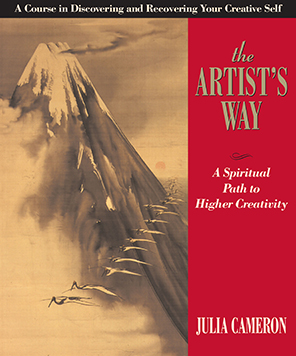
In the Artist's Way, Julia Cameron discusses a lot of negative and self-destructive habits that artists fall into out of fear and habit. Mostly fear I think. There's a couple passages that are hitting me where I live right now.
"We strive to be good, to be nice, to be helpful, to be unselfish. We want to be generous, of service of the world. But what we really want is to be left alone. When we can't get others to leave us alone, we eventually abandon ourselves. To others, we may look like we're there. We may act like we're there. But our true self has gone to ground . . . Afraid to appear selfish, we lose ourself. We become self-destructive. Because this self-murder is something we seek passively rather than consciously act out, we are often blind to its poisonous grip on us." (98)
Cameron describes artist who are self-destructive as lashing out when they reach a boiling point. They lash out and they are unable to accept help from others because they've been so destructive to themselves that when someone offers them something kind, they reject it because they believe somewhere deep that they don't deserve it or that it isn't real.
The really rough thing is that this behavior isn't clearly destructive either from the outside or the inside. It's hard to see because it's a constant denial of self. The sentence "Afraid to appear selfish, we lose ourself" strikes me so hard. I realized this week that I really don't know how to communicate when I am afraid and hurting. I try to behave in a logical, clear way so that conversations can continue and so that things can develop and I lose myself in whacking around with a baseball bat.
I also have to remember that I have needs and my fears often exist where I haven't taken care of my needs or where I am particular tender/wounded/recovering. But I fear that I have self-denialed and then judged myself for it for so long that I've lost touch with my self and the reactions that I am having. I don't understand the suffering anymore.
When I was in college, I was in a relationship with someone who was suffering themselves. At one point, in one argument, in reference to my excited recounting of my days and my activities, he snapped at me that I was "selfish" I never asked him how he was doing or what was happening. I told him that I expected that he would want to tell me and so asking wasn't necessary, but that word rang in my head like a cathedral bell:

It seemed to fill me up and not in the good way. I began to think that even if I couldn't see how, even if I was trying to take care of others or wanted them to be happy, everything I did was secretly selfish and harmful to others. The lesson I learned was this:
When I am excited about me and my things, I am selfish and therefore hurtful to others, especially those I love.
Looking back, I can see that he was a blocked artist lashing out at my happiness and joy when he wasn't feeling any. He has since apologized to me and I have been recovering. I can't blame him for it, because he was hurt too.I suppose that should count as some grace towards myself today when I accidentally flail. Provided that I try to make it right. Or maybe not even then, because self-care means to be gentle with the self. It means to take care of the self.
It's problematic and difficult for me because the Selfish label compounded with lessons I learned from church and bible school as a young Christian. I learned that selfishness is the only way to separate yourself from god--thinking you don't need him, that your self is more valuable than his is the fastest way to turn your back on him and therefore happiness and life-everlasting. The idea that happiness and peace come from god and that self-denial is the way to get them from him--of course, not because he is a withholding god, but because happiness naturally flows from following him--this idea underpins so much of the ideology of the social group in school and church of my childhood. God is Love. To deny yourself is to love god. God is an endless source of love if only you will deny yourself and follow him.
To realize that I was the selfish thing that kept god away was the biggest psychic whoops that I absorbed. Self-denial then = happiness and love. To get love to give love, I needed to deny myself and give give give give give.
My parents were remarkable and always made love available, which I think is a big reason why I'm not more of a mess today. But you see the problem don't you?
If you view self abasement, self denial, which really is self-destruction as the method for giving and receiving love, you fall into this trap that Cameron describes. You break yourself into a million pieces and shove them under the rug in order to care for others, lying to yourself that this is a loving act.

Under this paradigm it's no surprise that offers of care are met with terror. If someone wants to come in and care for you, you will find every explosive way to hide the mess that you are because you can't ever really hide from yourself just how hurt you are. Fear of discovery of that mess leads to all kinds of behavior. And if you're trying to communicate that mess, you're trying to communicate a hot ole mess. A hot, hot, hot mess. It's easy for that to feel like an atom bomb detonating everywhere.
So where does that leave you?
Julia Cameron has morning pages (writing every day) and an artist date that you must weekly do, alone, that feeds your soul. She also, in this particular chapter suggests writing down the list of things that you would do if they weren't too crazy or expensive or if it weren't too selfish.
Just now, none of that feels like it helps.
Most directions for self-care are like "take time for yourself, take care of yourself" How do you fucking do these things? Especially if most of your day, you already sit by yourself trying to work on things. I don't know. Very little of it makes sense to me. I suppose that's fair if most of my time I've been ignoring self and teaching myself to make that the standard of normal. The idea of self-care might be a confusing one.
In looking up images for self care, this one seemed helpful:

It allows me to address myself directly and the "You Have Permission" is a bolstering phrase and directive to have at the top there.
So let's try this.
Today I have permission to be kind to myself. No matter what, even though I think I have behaved badly, I will be kind to myself. Because I deserve to be kind to myself. Because I cannot be kind to others until I am kind to myself.
Today I will be kind to myself by: wow.... I can't believe how empty my brain is on how to finish this sentence.
How are you kind to yourself?

No comments:
Post a Comment