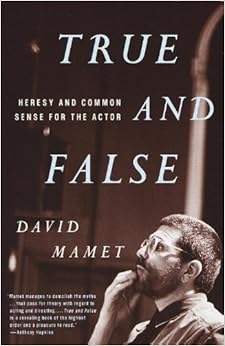
So, I've been reading a wonderful and provocative little pamphlet about acting and the theatre written by David Mamet. Maybe you've heard of it:
 As a performer and theatre maker who has chosen to pursue a PhD in theatre, many of his sharp words about institutions, acting teachers, and educational professionals were painful. If you haven't had the pleasure of this book, he makes statements like the following:
"Formal education for the player is not only useless, but harmful." (18)
"If you want to have made a valiant effort to go into the theatre before you go into real estate or law school or marry wealth, then perhaps you should stay in school." (19)
Woof! Scathing. After 22 years of formal education and three additional certificate programs in acting, I have to say this stings. So much.
Does he doom me to mediocrity with these statements? Does he condemn my choices as non-theatrical? Does he snatch away the possibility of meaningful work as a performer?
These are the feelings that I feel building at first as I read his statements against the institutions which I have given money, time, and energy to.
But as I continued to read I also began to feel other things, chief among them a sense of freedom and validation. As Mamet talks about how theatre and acting work, I realized that his condemnation of institutions arises not from a contempt of the desire to learn, but rather a contempt of the processes which obscure knowledge behind the prestige of a bureaucratic system of professors and workshops that place and actors value in the eyes of one or three or four professors, critics, or casting agents who keep actors away from audiences.
Mamet himself believes unreservedly in the skill and courage of the performer.
Take for instance this selection [hold on tight it's a bit more than a soundbite]:
Ok, so this is another hard one, but there is something in it that is so freeing that I wanted to stand up and shout. Many of the theatrical authority figures I have known and much of the general buzz about the business are about auditions, proving yourself, getting an A, getting X director's approval, making sure that the critic/camera sees a great performance. But the definition of great performance was some external grading system to which actors are consistently asked to measure up to. How do we know if we've hit it? A feeling? A special nod from the director? Fewer notes? More notes? Callbacks?
Hold yourself in, Lose ten pounds, Up-endings, Vary your pitch, Make bolder choices, Find the Right Monologue
It's hard enough to break your own filter and respond truthfully to another human being in an uncertain situation and that is drama. That is theatre. Human beings responding truthfully, doing things in an uncertain situation.
This is not to say that the desire to understand, discuss ideas, concepts, contexts, and relevant materials is wrong, but rather to say that an actor's job is hard enough without making them responsible for the answers to questions which the play asks the audience.
This tips a piggy-back idea, that I'll probably put in another blog post: the Audience is not a passive reviewer passing judgement. They are a partner who connects the dots around the action of the play.
Back to the actor's job: professors, casting directors, --even sometimes directors-- who ask actors to add the answers to extra dramatic questions can complicate and ultimately make the actor responsible for the audience's job. Think about that for a second: trying to do both the job of performer and the job of viewer. That's a mind numbing and ultimately impossible job. Success in this case is merely a fulfilling of said persons ideal dream of the character, which often says more about that person than about either the play or the actor performing the role.
But Self--my brain questions--what about fantastic roles? or non-realistic plays which require the imagination? or conceptual plays which deal with ideas? The really fun stuff.
That's an excellent question, Self.
No play is realistic [even Realistic ones] because they're played by actors on a stage and viewed by an audience. Which means that the given circumstances of the world of any play are going to be non-realistic in some way shape or form. Imagination is certainly a part of theatre and acting. A beautiful part.
Mamet suggests, however, that instead of trying to "believe" in the imaginary circumstances, we trust the playwright. Here, I include our collaborators and world builders. Trying to believe is illusive, difficult, and can lead to devastation and guilt: I'm not believing good enough. I'm not right. Why can't I just believe it? Etc. Mamet suggests that instead of trying to make ourselves believe, we accept the circumstances as they come and respond by bravely taking the next action and line that present themselves.
I don't know about you, but this is such a liberating notion for me. As a performer, an actor, an imaginer, and a person.
You don't have to have it right. You don't have to emote the correct thing. You don't have carry the weight of believing.
You get to accept a surprising, dangerous, exciting set of circumstances and DO something with them.
Ugh! It feels so good because it's hard, but brave. And how do you know it's done? I did it.
What did they think? That's their purview. They get to have their opinions, but if your job is definable. Ie: to tell the audience a story. You know when you did it. You can plan to do better. You can do it again.
Gah! Now I'm just devolving. Make Theatre! Tell Stories! Act Bravely! Speak truthfully! Syllable Syllable Syllable! Recorded Time is not so petty!
Anyway, I'll continue reading. More thoughts to follow. Lots to consider. Lots to validate. Things.
"Formal education for the player is not only useless, but harmful." (18)
"If you want to have made a valiant effort to go into the theatre before you go into real estate or law school or marry wealth, then perhaps you should stay in school." (19)
Woof! Scathing. After 22 years of formal education and three additional certificate programs in acting, I have to say this stings. So much.
Does he doom me to mediocrity with these statements? Does he condemn my choices as non-theatrical? Does he snatch away the possibility of meaningful work as a performer?
These are the feelings that I feel building at first as I read his statements against the institutions which I have given money, time, and energy to.
But as I continued to read I also began to feel other things, chief among them a sense of freedom and validation. As Mamet talks about how theatre and acting work, I realized that his condemnation of institutions arises not from a contempt of the desire to learn, but rather a contempt of the processes which obscure knowledge behind the prestige of a bureaucratic system of professors and workshops that place and actors value in the eyes of one or three or four professors, critics, or casting agents who keep actors away from audiences.
Mamet himself believes unreservedly in the skill and courage of the performer.
Take for instance this selection [hold on tight it's a bit more than a soundbite]:
- "It calls on the actor not to do more, not to believe more, not to work harder as part of industrial effort, but to act, to speak out bravely although unprepared and frightened.
- The middle-class work ethic: "But I did my preparation. It is not my fault if the truth of the moment does not conform." That ethic is not going to avail. Nobody cares how hard you worked. Nor should they.
- Acting, which takes place for an audience, is not as the academic model would have us believe. It is not a test. It is an art, and it requires not tidiness, not paint-by-numbers intellectuality, but immediacy and courage.
- We are of course trained in our culture to hold our tongue and control our emotions and to behave in a reasonable manner. So, to act one has to unlearn these habits, to train oneself to speak out, to respond quickly, to act forcefully, irrespective of what one feels and in so doing to create the habit, not of "understanding," not of "attributing," the moment, but of giving up control and, in so doing, giving oneself up to the play." (32)
Ok, so this is another hard one, but there is something in it that is so freeing that I wanted to stand up and shout. Many of the theatrical authority figures I have known and much of the general buzz about the business are about auditions, proving yourself, getting an A, getting X director's approval, making sure that the critic/camera sees a great performance. But the definition of great performance was some external grading system to which actors are consistently asked to measure up to. How do we know if we've hit it? A feeling? A special nod from the director? Fewer notes? More notes? Callbacks?
Hold yourself in, Lose ten pounds, Up-endings, Vary your pitch, Make bolder choices, Find the Right Monologue
It's hard enough to break your own filter and respond truthfully to another human being in an uncertain situation and that is drama. That is theatre. Human beings responding truthfully, doing things in an uncertain situation.
This is not to say that the desire to understand, discuss ideas, concepts, contexts, and relevant materials is wrong, but rather to say that an actor's job is hard enough without making them responsible for the answers to questions which the play asks the audience.
This tips a piggy-back idea, that I'll probably put in another blog post: the Audience is not a passive reviewer passing judgement. They are a partner who connects the dots around the action of the play.
Back to the actor's job: professors, casting directors, --even sometimes directors-- who ask actors to add the answers to extra dramatic questions can complicate and ultimately make the actor responsible for the audience's job. Think about that for a second: trying to do both the job of performer and the job of viewer. That's a mind numbing and ultimately impossible job. Success in this case is merely a fulfilling of said persons ideal dream of the character, which often says more about that person than about either the play or the actor performing the role.
But Self--my brain questions--what about fantastic roles? or non-realistic plays which require the imagination? or conceptual plays which deal with ideas? The really fun stuff.
That's an excellent question, Self.
No play is realistic [even Realistic ones] because they're played by actors on a stage and viewed by an audience. Which means that the given circumstances of the world of any play are going to be non-realistic in some way shape or form. Imagination is certainly a part of theatre and acting. A beautiful part.
Mamet suggests, however, that instead of trying to "believe" in the imaginary circumstances, we trust the playwright. Here, I include our collaborators and world builders. Trying to believe is illusive, difficult, and can lead to devastation and guilt: I'm not believing good enough. I'm not right. Why can't I just believe it? Etc. Mamet suggests that instead of trying to make ourselves believe, we accept the circumstances as they come and respond by bravely taking the next action and line that present themselves.
I don't know about you, but this is such a liberating notion for me. As a performer, an actor, an imaginer, and a person.
You don't have to have it right. You don't have to emote the correct thing. You don't have carry the weight of believing.
You get to accept a surprising, dangerous, exciting set of circumstances and DO something with them.
Ugh! It feels so good because it's hard, but brave. And how do you know it's done? I did it.
What did they think? That's their purview. They get to have their opinions, but if your job is definable. Ie: to tell the audience a story. You know when you did it. You can plan to do better. You can do it again.
Gah! Now I'm just devolving. Make Theatre! Tell Stories! Act Bravely! Speak truthfully! Syllable Syllable Syllable! Recorded Time is not so petty!
Anyway, I'll continue reading. More thoughts to follow. Lots to consider. Lots to validate. Things.


