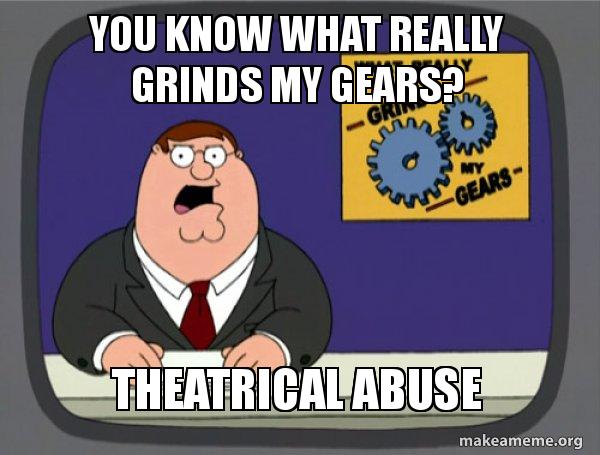
I was talking to some friends about theatre and generally how people get pigeonholed by the work available: actors become yoga teachers, designers become technical directors, directors become stage managers. Not to denigrate any of these positions, but it is difficult (and the subject of another post) to not be able to do the work that you want to do (in any job/position). Point being! This article on Profiles in Chicago came up in conversation. I had not read the article at the time and so knew very little about it except that it had to do with exploitation of performers.
Then I read the article, and HOLY HOT DOGS, BATMAN!
Talk about a goddamn horror story.

Here are the cliff's notes:
Profiles is a theatre company in Chicago with a reputation for excellent, biting, edgey realism. They're in the tradition of Steppenwolf and some of their most famous productions have been scripts by Sam Shepherd and Tracy Letts. These productions have been called "Vicious" because the stage drama, the tension, the violence, everything is so real--they're really doing it.
This is where things get weird and scary. They really were. The violence--mental and physical--were intensely real. The entire company was wound around their primary actor-manager who systematically controlled, groomed, and abused the entire company.
Please read the article for more in-depth details, but know that this involved helping/grooming/sleeping with younger and leading actresses, flash changes of opinion and screaming at actors for ruining scenes, isolating performers, teaching classes and bringing actors into the company from these classes where he could groom them while they were young, and creating un-safe work environments on the ideals of edge-y, hardcore work in a company that 'valued' them and the ever popular--sacrificing yourself for the work.
Performers, Stage Managers, and anyone who interfered or said stop/unsafe was isolated and kicked out. Performers were gas-lit and ambushed. And because they were young and because the theatre was not-equity there was no where for these theatre-makers to turn.
Now, this lights a fire under my ass for a variety of reasons.
- Safety. Theatre makers, like any worker--like any goddamn human beings, deserve to be safe in the workplace. This includes things like: recourse for inappropriate behavior, human hours, non-toxic social milieus,
- The disregard for designers and directors--the company made up fictional designers and directors to hide the fact that this actor-manager and his partner were in total control of this company. Making a mockery of the fact that collaboration with multiple artists yields excellent art.
- Cult-leaders/AbusiveGurus--This shit is not ok!! The behavior conditioning that makes you feel crazy for having feelings/opinions of your own, the isolation direct and indirect, the casting of and grooming of young actresses, the abuse of the role of teacher/mentor--THIS SHIT IS NOT OK!!
- The Disposability of Actors: The message that is thrown at us from an early time is that if we are difficult, complain, or piss off those in positions of power: We are replaceable. Even the funny "actors are replaceable, props are not" shit. Especially female actors. We are told through the sheer number of us that we are replaceable. No one has time for anything but excellent compliance from us.
The thing that really fucking gets me is that I recognize so many of these actions and styles of theatrical creation. I have experienced them.
The first time I was cast in a big festival, I played Juliet. On the phone before I was offered the part, I was asked not only if I was comfortable with sexuality on stage, but also if I was a virgin. The actor-manager of this company consistently hired and chased after young women. When we were doing an educational outreach, the back of my Juliet dress came undone while we were all waiting in the side room of the auditorium. I asked for help and he jumped on it and not only did my dress up but also kissed me on the side of the neck. He was the most powerful person in the room and I didn't dare say anything. I'd heard him talk about other actors. I just thanked my stars that I wasn't playing Ophelia to his Hamlet (another show that season) which he was also directing. She had a particularly violent and sexual Get Thee To a Nunnery. The actor-manager's philander-y nature was an open secret. The cast talked about it. He encouraged us to vent to each other at the beginning of the season because he warned us that he was going to yell at us, push us up to the edge of the cliff--but, he explained, it was all in the service of art and we were a family. He made us feel like we were special to be part of this festival.
After this festival, my director was heard to say of me that I was a good actor, I just needed a strong male director.
I have seen friends asked to send nude images of themselves before even attending an audition. I have seen directors who demand that students merely acquiesce to their notes like automatons and then criticize them for having no originality. I have seen directors actively seek dangerous situations and as an actor, I have been willing and excited to seek those situations as well, especially when I was younger and less experienced.
I have seen people who want desperately to guide young actors and give them freedom and help create dangerous situations. I have been in situations where, despite creating incredible art, I did not feel safe or valued in the rehearsal process and I was willing again and again to let someone else dictate to me how far to push it and to jump into unsafe places because I knew I was replaceable, I wanted to get hired again, I wanted to make great art, I believed in the dream.
So all of this really screams towards the question:
How do we create a safe collaborative space for theatre makers here, where we are?
I have worked with many fine performers and directors and collaborators and have several ideas, which hopefully will become further blog posts. But today I want to turn the question out first and ask you readers:
- What have been the safest collaborative spaces?
- What helped make them safe?
- How can we work to bring those to environments we are already working in?
- How can we create safe and collaborative spaces for theatre?

This comment has been removed by a blog administrator.
ReplyDeleteThis comment has been removed by a blog administrator.
ReplyDelete