Monday, November 21, 2016

A Response to "Left's freak out over Trump's win is absurd"

To Cynthia M. Allen;

Your charge last week in the Star Tribune that liberals are responding inappropriately to Trump’s election is erroneous.

There are three claims that I want to address.

First, that the “normal and appropriate response would be to wait until Trump’s tenure has begun and then to hold him accountable for his decisions as president.” To this, I counter that he has begun his tenure. His statements and actions as a representative of the nation have begun as he assembles his cabinet and states his goals. These are decisions that do and will effect this country. In fact, they have. There has been a documented and verified spike in hate crimes committed by individuals who, regardless of their votes, feel both comfortable and supported in their threats and violence against the visible and marginalized in this country. 

You secondly claim that liberals are “Sniveling and whining” which “is not the way to build empathy for your cause.” You assume that the crying and the need for safe spaces is an argument and plea for your empathy. These visible marginalized groups are people that Trump has not only spoken rude and violent rhetoric against, they are individuals who are attacked emotionally, verbally, physically, and, with Trump and those he is beginning to tap for office, legally. Those who are attacked and abused need a safe space not to appeal to your emotions, but to literally protect and care for themselves in an increasingly open and hostile socio-political climate. 

Which brings me to your third claim that the “basic tenets of our democracy [are]—that even if you didn’t vote for the person who wins, that person is still your president.” First this is not tenet (a principle or belief). The person who is voted into office fills that office and this is a function not a principle. The basic principle that allows democracy to proceed is that those who are in the majority (in power) consent to care for the interests of the minority (not in power).  This is something that Trump and his regime have stated that they are deliberately against. Without the behavior of care towards and for the minority and the marginalized, these individuals have no incentive to submit to the authority of a majority elected representative. This leads to protests and political action in order to protect the rights that the democracy guarantees it’s citizens. This principle is a literal requirement for democracy because the the government cannot continue on democratic rule if it does not care for the minority. It instead is forced to become a different kind of government: one that forces it’s control.

This brings me back to the first point. You ask that liberals “Please stop” their behavior and “wait”. You offer to support this request that you are also worried about Trump’s policies and you are waiting. I then ask, what will you do to stop those policies you are fearful of? If you are concerned, how will you actively participate in your democratic duty to hold Trump and his regime accountable for those behaviors since you did not vote for him? There are citizens and individuals in this country in danger from these policies and ideas. While it might not be true to say that every Trump voter voted because they were in favor of racist, sexist, and bigoted policies, they definitely didn’t find these policies to be an impediment as you seem to have (since you say you did not vote for him). And I ask again, what will you do to ensure that these policies are not enacted?

You wrote an op-ed to justify your “schaudenfreude”—a word you chose that translates literally to express your joy in someones misfortune and suffering—forgive me if your fears for the safety of the vulnerable in this society seem hollow.  

Friday, June 10, 2016

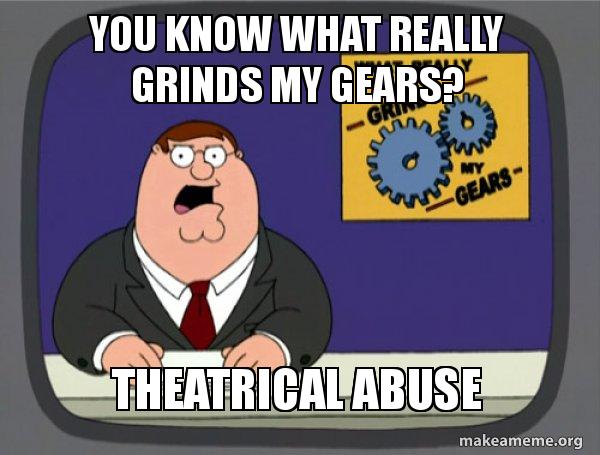
You Know What Really Grinds My Gears? Theatrical Abuse


I was talking to some friends about theatre and generally how people get pigeonholed by the work available: actors become yoga teachers, designers become technical directors, directors become stage managers. Not to denigrate any of these positions, but it is difficult (and the subject of another post) to not be able to do the work that you want to do (in any job/position). Point being! This article on Profiles in Chicago came up in conversation. I had not read the article at the time and so knew very little about it except that it had to do with exploitation of performers.

Then I read the article, and HOLY HOT DOGS, BATMAN!

Talk about a goddamn horror story.


Here are the cliff's notes:

Profiles is a theatre company in Chicago with a reputation for excellent, biting, edgey realism. They're in the tradition of Steppenwolf and some of their most famous productions have been scripts by Sam Shepherd and Tracy Letts. These productions have been called "Vicious" because the stage drama, the tension, the violence, everything is so real--they're really doing it.

This is where things get weird and scary. They really were. The violence--mental and physical--were intensely real. The entire company was wound around their primary actor-manager who systematically controlled, groomed, and abused the entire company.

Please read the article for more in-depth details, but know that this involved helping/grooming/sleeping with younger and leading actresses, flash changes of opinion and screaming at actors for ruining scenes, isolating performers, teaching classes and bringing actors into the company from these classes where he could groom them while they were young, and creating un-safe work environments on the ideals of edge-y, hardcore work in a company that 'valued' them and the ever popular--sacrificing yourself for the work.

Performers, Stage Managers, and anyone who interfered or said stop/unsafe was isolated and kicked out. Performers were gas-lit and ambushed. And because they were young and because the theatre was not-equity there was no where for these theatre-makers to turn.

Now, this lights a fire under my ass for a variety of reasons.


  1. Safety. Theatre makers, like any worker--like any goddamn human beings, deserve to be safe in the workplace. This includes things like: recourse for inappropriate behavior, human hours, non-toxic social milieus, 
  2. The disregard for designers and directors--the company made up fictional designers and directors to hide the fact that this actor-manager and his partner were in total control of this company. Making a mockery of the fact that collaboration with multiple artists yields excellent art. 
  3. Cult-leaders/AbusiveGurus--This shit is not ok!! The behavior conditioning that makes you feel crazy for having feelings/opinions of your own, the isolation direct and indirect, the casting of and grooming of young actresses, the abuse of the role of teacher/mentor--THIS SHIT IS NOT OK!!
  4. The Disposability of Actors: The message that is thrown at us from an early time is that if we are difficult, complain, or piss off those in positions of power: We are replaceable. Even the funny "actors are replaceable, props are not" shit. Especially female actors. We are told through the sheer number of us that we are replaceable. No one has time for anything but excellent compliance from us. 

The thing that really fucking gets me is that I recognize so many of these actions and styles of theatrical creation. I have experienced them.

The first time I was cast in a big festival, I played Juliet. On the phone before I was offered the part, I was asked not only if I was comfortable with sexuality on stage, but also if I was a virgin. The actor-manager of this company consistently hired and chased after young women. When we were doing an educational outreach, the back of my Juliet dress came undone while we were all waiting in the side room of the auditorium. I asked for help and he jumped on it and not only did my dress up but also kissed me on the side of the neck. He was the most powerful person in the room and I didn't dare say anything. I'd heard him talk about other actors. I just thanked my stars that I wasn't playing Ophelia to his Hamlet (another show that season) which he was also directing. She had a particularly violent and sexual Get Thee To a Nunnery. The actor-manager's philander-y nature was an open secret. The cast talked about it. He encouraged us to vent to each other at the beginning of the season because he warned us that he was going to yell at us, push us up to the edge of the cliff--but, he explained, it was all in the service of art and we were a family. He made us feel like we were special to be part of this festival.

After this festival, my director was heard to say of me that I was a good actor, I just needed a strong male director.

I have seen friends asked to send nude images of themselves before even attending an audition. I have seen directors who demand that students merely acquiesce to their notes like automatons and then criticize them for having no originality. I have seen directors actively seek dangerous situations and as an actor, I have been willing and excited to seek those situations as well, especially when I was younger and less experienced.

I have seen people who want desperately to guide young actors and give them freedom and help create dangerous situations. I have been in situations where, despite creating incredible art, I did not feel safe or valued in the rehearsal process and I was willing again and again to let someone else dictate to me how far to push it and to jump into unsafe places because I knew I was replaceable, I wanted to get hired again, I wanted to make great art, I believed in the dream.

So all of this really screams towards the question:

How do we create a safe collaborative space for theatre makers here, where we are?

I have worked with many fine performers and directors and collaborators and have several ideas, which hopefully will become further blog posts. But today I want to turn the question out first and ask you readers:

  • What have been the safest collaborative spaces? 
  • What helped make them safe? 
  • How can we work to bring those to environments we are already working in?
  • How can we create safe and collaborative spaces for theatre?

Sunday, January 31, 2016

Wuthering Heights: Fiends on the Moor

Dante Gabriel Rosetti wrote in a letter that Wuthering Heights--the first novel he'd read in a while was:

"The action is laid in hell, — only it seems places and people have English names there."

I would argue that the infamous quote: "Hell is other people" applies.

Is hell the location of the story? The action of the story? Or the people of the story?

The moors are certainly desolate and so are the houses, but they exist as a social space. Like Sartre's famous play (No Exit), these characters are isolated and confined. They isolate, confine, and define each other through the story.


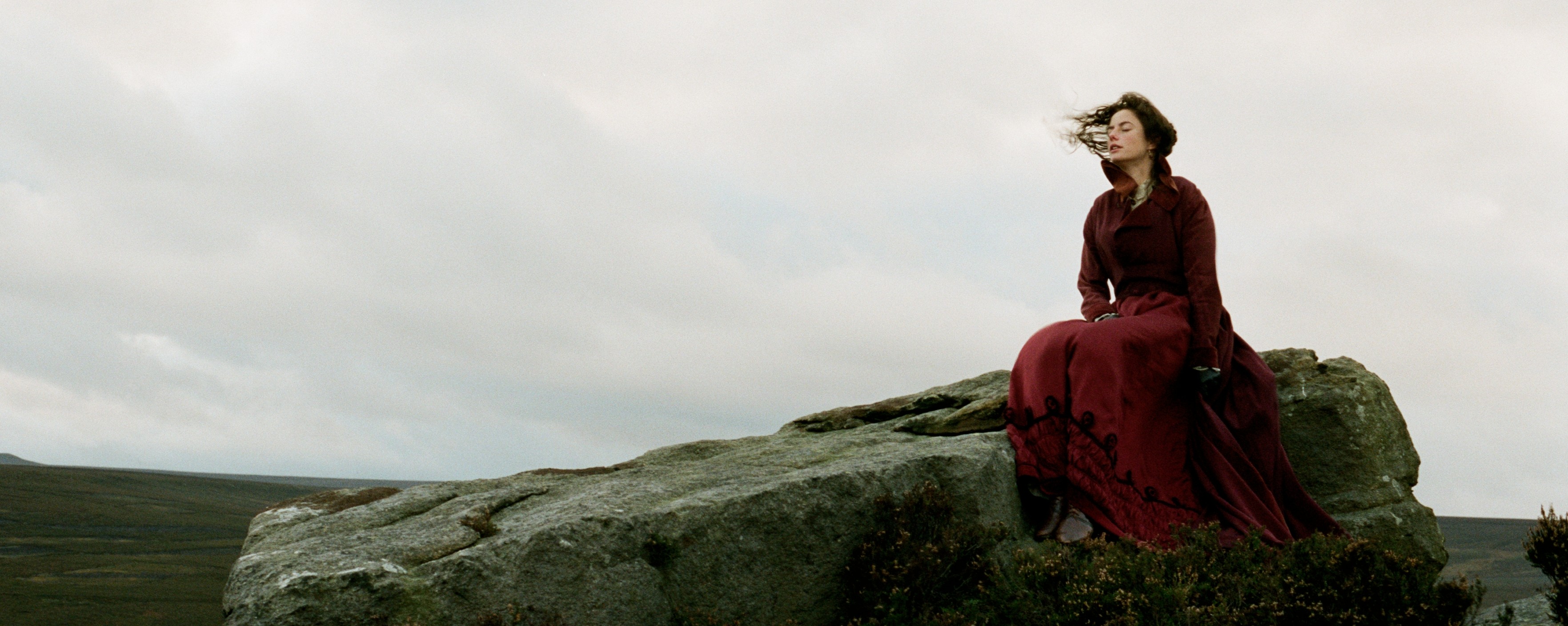
Ah, the English Moors . . . 

It's like a room full of mirrors in which the characters reflect their pain and then try to smash each other over and over in order to stop it. Everyone thinking that destroying the fiend will create happiness.

Where is the fiend?

Every character attributes the fiend to someone outside themselves that they cannot escape.

Now this is the first time that I have read Wuthering Heights and I admit that I was baffled most of the way through the book. Everything that I knew about it before I read it was that it was a tragic love story between Catherine and Heathcliff. So it was confusing to be to begin with neither one of them, but with Lockwood and Nelly Dean.

Felt about like that.

Nelly Dean who has been present for the entirety of the story and relates it to Lockwood and through Lockwood to the reader.

I asked: Who is the protagonist?

It took me a while but the book actually spans the lifetime of Heathcliff (as Cathy herself dies half way through the book--at what wikipedia tells me is the end of the first volume). So I thought perhaps Heathcliff is the protagonist.

And throughout the narrative the question seems to be--what kind of a fiend is Heathcliff? This ferocious goblin of a man that old Mr. Earnshaw plucked from the streets of London and introduced into the bosom of his home igniting a chain of strife that only ends with Heathcliff's death.

What kind of fiend is Heathcliff?

But who is asking this question? Why is this question foremost in the narrative?

Then I reached an interesting moment:

When Heathcliff kidnaps Cathy Linton and Nelly Dean to force Cathy to marry Linton Heathcliff. Nelly remarks that all night she believed that none of this would have happened if she had been able to carry out her duties properly. And she's talking all of it. From the moment of child Heathcliff's arrival at Withering Heights to the kidnapping.

Why is this interesting to me?

Because Nelly actually narrates the whole story, frames every action and speech given by the Earnshaws, the Lintons, and the Heathcliffs. She frames the story and she is a primary character.  The wikipedia character relationship chart mistakenly calls her an "observer" in the story. But she is a primary mover.

She keeps characters apart, allows them together, carries tales, doesn't carry tales, she chaperones, she provides opportunities for things to happen. She counsels characters, chides them, she influences characters.

She is a lynch pin in the whole narrative, without whom the story could not happen.

She could have told Heathcliff that Cathy loved him when she knew that he left after she said marrying him would leave them poor and degraded though she loved him as her own soul and would sacrifice marrying Linton to advance him in life. Important moments, y'all.

And only ONCE does she question her own culpability in this tale. Frequently she asks from whence Heathcliff has come and how is he a fiend. She judges other characters actions and even excuses herself from culpability by pointing to her own feebleness of limb (couldn't run fast enough) or social trapitude (station as servant or the situation or the other character's incredible will).

She lies to the other characters to get them to obey: "Linton, try to love your father Heathcliff and he will love you".

She steals Cathy Linton's love letters from Linton Heathcliff.

She agrees to things she hates.

She verbally abuses in situations that she admits to seeing how it's caused by hurt and not bad character.

--at this point, I again feel that no character is without hurtful, awful actions in this book--

But I continue to come back to our narrator because she is the only prevailing character through the whole narrative. Much like Barbara--in Zoe Heller's Notes on a Scandal--Nelly Dean is a character who tells the story of a scandal outside of herself, claiming to be an observer. However, both Barbara and Nelly are far more embroiled than either admits to. Both characters take actions and push the tragic central characters into things through advice or action, while ignoring their part in it.

I find these kinds of narrators fascinating. Especially in this case because I've never heard anyone mention Nelly Dean. She made it through the whole story receiving minimum physical violence (unlike just about every other character) and without too much emotional violence directed at her. Yet she has her hands in everything!

Do we wish to be Catherines and Heathcliffs and Haretons because we believe ourselves to be Lockwoods and Deans and therefore observers?

What is the question I want to ask?

Why do we love Heathcliff and Catherine and Hareton in spite of their horrendous behavior?

Why do we ignore Nelly Dean? Why does Nelly forgive them?

I certainly think this story deserves its place in the cannon, but is it a love story? (subject for another blog post)

What kind of a story is it really? Why are we drawn to it and its cycles of violence?

Perhaps it's just that gorgeous english moor? or the homely horror of the hauntings of each tragic death?

It's definitely a haunting, violent, and troubling narrative--despite its "happy"? ending?

I leave you with my favorite piece of at inspired by Wuthering Heights--Kate Bush's music video of the same title.