This week I read "An open letter to that jerk who sat behind me at the public dress rehearsal for Frida". It was published by the metrotimes.com

I have to admit that I had mixed and complicated feelings about it. On the one hand, I've been in audiences where one or two people aren't sharing in the event like everyone else.
For example, I saw a devastating production of the Glass Menagerie at the Old Globe Theatre in San Diego and at the end a couple women behind me immediately began to talk about the color of cushions. At a show at the Hilberry, someone down the row of seats from me had an iPad out during the show--blue screen lighting up all the things.
Additionally, some of the behavior described in the letter does sound both distracting and disconnected from the show. For example:
"you and your friends ignored the standing ovation afforded the cast and musicians and you asked, so as to be heard over the thunderous applause, “Does anybody know the score of the Michigan game?” "
that he "mention[ed] you were a psychologist at least three times throughout "
that he didn't applaud at the end of the show. "What kind of person doesn’t applaud at the end of a live show? "
In a content level, the author of the letter, Nicholas Bitonti, indicates that the other audience member talked derisively with his companions throughout the show, didn't applaud, and did all with an attitude that conveyed an unwillingness to engage with what was going on. It gets complicated for me because of the tone in which the letter is written. It is vitriolic in the extreme and doles out plenty of derisive spirit on its own.
For example:
"I’ve just one question for you, you half-bearded twat: If one doesn’t enjoy the opera, why go? "
"I remember you and your two friends. How could I forget your searing, South Eastern Michigan voices hot in my ear, disrupting the sounds of a world-class opera company and orchestra with comments such as “Ewww. That was awkward.” What was awkward? Was it that Frida Kahlo’s lifelong struggle with injuries sustained as a child was examined in the libretti? I’ll tell you what’s awkward you: A trio of art-hating pseudo-hipster malcontents going to an opera, putting their feet up on the seats, and talking at a high volume throughout the entire performance."
"My dear trust fund hipster container of men’s effluent, you are the one who drives people away from this city. "
This level of derision makes me deeply uncomfortable. I think because opera and often theatre is considered an elite art form. There's something already separate and venerated about it that can turn off people who feel that they are neither welcome nor a part of the audience/performance dialogue.
A couple things pop up here for me: first is that having neither been present at the event, nor seen the opera in question, I am a little out of the loop here. I spoke to a friend who was actually [happily] a performer in the opera in question. He was able to shed a little more light on the disengagement of the particular trio in question. Apparently, they were disruptive enough to be a bother not only to Bitonti but also to the performers. But the letter also engenders a resentment as a theatre-goer who likes to enjoy performances vocal, who appreciates the active role of audience in theatrical sharing, who has been told by audience members to laugh quieter, respond less, and enjoy inside instead of communally.
So, I ask how do audiences and the performers communicate during an act of theatrical sharing?
This question seems to be the heart of the issue. In the communal event of theatrical performance and presentation and act which shares the talent, skill, and artistic collaborating with an audience of witnesses. How does/should communication take place? How do we negotiate that relationship? How can we acknowledge our feelings of frustration, our feelings of boredom, our feelings of hope, our loud and quiet feelings, with a group across the line that separates us from the performance?
To interact here, I want to share a couple observations from Sarah Ruhl's lovely book 100 Essays I Don't Have Time to Write: on umbrellas and sword fights, parades and dogs, fire alarms, children, and theater. Phew! What a mouthful! [I LOVE IT] Specifically, a couple observations about audiences and performance.
First is from "Chimpanzees and audiences": Ruhl discusses an experiment in which humans watched chimps with, deliberately, no expression. The apes went crazy--in a bad way. She notes that "The audience helps to create an aesthetic object through a process of biofeedback." (106)
 [The above picture is from The Moral Menagerie blog--a blog post about Mammalomorphism, "our innate recognition of the emotional states of fellow mammals based on shared postures"]
The response of an audience is necessary for the energy of the performance. Sometimes we can see them and sometimes we can't. Both verbal and visual postures can be involved. We have to know, as performers, that what we are sharing is landing, somehow, whether that is boos, laughter, cheers, smiles, frowns, leaning forward, leaning back, looking at a phone etc. Which to me seems to indicate that active engagement with the performers is a gift. On the other hand, the lack of engagement or the derisive engagement seems to be a deliberate middle-finger. This is where I can understand and get behind the rage Bitonti expresses. When the gift of performance, skill, and love is shared, it is infuriating to have it thrown back in your face. Devastating.
The question this brings up is: What is considered appropriate engagement? Who decides appropriateness? Hows is that communicated? How can audiences give the gift of responding?
Personally, I actively hate the silent viewing. I am actively angered by audience members who say shut up, don't feel, don't express, to other audience members. Especially when I want to respond to the gift that the performers are giving me. So how can we create an environment/dialogue with audiences to negotiate the kind of interaction we will have? This might be a lot of work, but I think it's worth it. Because if audience response is something that makes the performers frustrated or interrupts the experience of others, then lets talk about how we want to work here. What can we agree on? What is the aesthetic of this performance? What is the language of sharing? Because I can accept if someone can't hear or if the performers want to share into a silent house or if they prefer for an audience to be toned down, but then I want to have some kind of dialogue rather than expectations which are "known" and "expected" and used to slap audience members around.
One of my favorite examples of this was actually at Stratford, during a performance of Cimbeline when an audience member's cell phone rang. The actors stopped the scene and waited. It took a while and as it continued to ring, one actor turned and looked into the audience toward the ringing. The audience laughed. We understood. The actors clearly communicated that they heard us and knew that things happen. The moment was acknowledged and we all continued. It was live performance! The audience and the actors were both part of this. The moment ended and the show continued. I felt warm and fuzzy about the experience. My anger/irritation with the ringer dissipated and I didn't miss anything in the show. In fact, I felt closer to them because they had acknowledged our part in the event as audience members.
Along these lines, I come to a second small essay of Sarah Ruhl's: "Buber and the stage" which is about Martin Buber's conception of interrelational roles specifically I and Thou. Ruhl asks "How to give an audience an I/Thou relationship with the stage rather than an I/It relationship with the stage?" (111)
How can the audience be encouraged to see and respond to what is happening on stage as an unfolding present gift of sharing from person entities rather than as a presented object/product? Additionally, How can the stage/performers see and respond to what is happening the audience as a gift of attention and response from a group of thou's rather than an reduced "it"--a fickle group think beast?
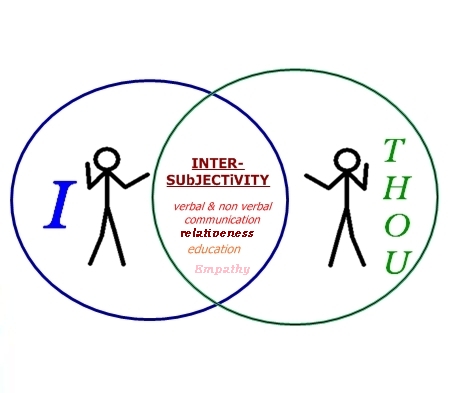
Ruhl notes "I'm not sure if this desire to create a "thou" in the theater is shared in the contemporary American climate, where is seems we put all our efforts into becoming more of an "it"--glossy, cinematic, bold." (112)
This product oriented theater which asks "was it good?" instead of "what happened?" is one which encourages it relationships. We look at the product of the performance and nitpick through it. I'm as guilty of this as the next person. I often feel a little ungenerous, but I also see productions which focus on a glossy product--if that is the focus, in which a forth wall is imposed and the actors are directed to ignore the audience, it is much easier to fall into treating it as an object. Is this wrong? I don't know. But I do know that I have found piece in which the performance acknowledges and dialogues with the audience in some way to be moving in a way that does not require perfection, glossy or otherwise.
Being acknowledged and shared with allows me to find things wonderful that are imperfect, find things moving even when I see another way to do it, feel included even if I disagree.
I think sharing is one of the huge things that differentiates live performance from filmed, broadcast, painted, or written.
So, how can we acknowledge the experience together as audience and performance? Whether we like sports arena style response (eating, drinking, carousing) or hushed attention? How can we foster I/Thou performances?

I have to admit that I had mixed and complicated feelings about it. On the one hand, I've been in audiences where one or two people aren't sharing in the event like everyone else.
For example, I saw a devastating production of the Glass Menagerie at the Old Globe Theatre in San Diego and at the end a couple women behind me immediately began to talk about the color of cushions. At a show at the Hilberry, someone down the row of seats from me had an iPad out during the show--blue screen lighting up all the things.
Additionally, some of the behavior described in the letter does sound both distracting and disconnected from the show. For example:
"you and your friends ignored the standing ovation afforded the cast and musicians and you asked, so as to be heard over the thunderous applause, “Does anybody know the score of the Michigan game?” "
that he "mention[ed] you were a psychologist at least three times throughout "
that he didn't applaud at the end of the show. "What kind of person doesn’t applaud at the end of a live show? "
In a content level, the author of the letter, Nicholas Bitonti, indicates that the other audience member talked derisively with his companions throughout the show, didn't applaud, and did all with an attitude that conveyed an unwillingness to engage with what was going on. It gets complicated for me because of the tone in which the letter is written. It is vitriolic in the extreme and doles out plenty of derisive spirit on its own.
For example:
"I’ve just one question for you, you half-bearded twat: If one doesn’t enjoy the opera, why go? "
"I remember you and your two friends. How could I forget your searing, South Eastern Michigan voices hot in my ear, disrupting the sounds of a world-class opera company and orchestra with comments such as “Ewww. That was awkward.” What was awkward? Was it that Frida Kahlo’s lifelong struggle with injuries sustained as a child was examined in the libretti? I’ll tell you what’s awkward you: A trio of art-hating pseudo-hipster malcontents going to an opera, putting their feet up on the seats, and talking at a high volume throughout the entire performance."
"My dear trust fund hipster container of men’s effluent, you are the one who drives people away from this city. "
This level of derision makes me deeply uncomfortable. I think because opera and often theatre is considered an elite art form. There's something already separate and venerated about it that can turn off people who feel that they are neither welcome nor a part of the audience/performance dialogue.
A couple things pop up here for me: first is that having neither been present at the event, nor seen the opera in question, I am a little out of the loop here. I spoke to a friend who was actually [happily] a performer in the opera in question. He was able to shed a little more light on the disengagement of the particular trio in question. Apparently, they were disruptive enough to be a bother not only to Bitonti but also to the performers. But the letter also engenders a resentment as a theatre-goer who likes to enjoy performances vocal, who appreciates the active role of audience in theatrical sharing, who has been told by audience members to laugh quieter, respond less, and enjoy inside instead of communally.
So, I ask how do audiences and the performers communicate during an act of theatrical sharing?
This question seems to be the heart of the issue. In the communal event of theatrical performance and presentation and act which shares the talent, skill, and artistic collaborating with an audience of witnesses. How does/should communication take place? How do we negotiate that relationship? How can we acknowledge our feelings of frustration, our feelings of boredom, our feelings of hope, our loud and quiet feelings, with a group across the line that separates us from the performance?
To interact here, I want to share a couple observations from Sarah Ruhl's lovely book 100 Essays I Don't Have Time to Write: on umbrellas and sword fights, parades and dogs, fire alarms, children, and theater. Phew! What a mouthful! [I LOVE IT] Specifically, a couple observations about audiences and performance.
First is from "Chimpanzees and audiences": Ruhl discusses an experiment in which humans watched chimps with, deliberately, no expression. The apes went crazy--in a bad way. She notes that "The audience helps to create an aesthetic object through a process of biofeedback." (106)
The response of an audience is necessary for the energy of the performance. Sometimes we can see them and sometimes we can't. Both verbal and visual postures can be involved. We have to know, as performers, that what we are sharing is landing, somehow, whether that is boos, laughter, cheers, smiles, frowns, leaning forward, leaning back, looking at a phone etc. Which to me seems to indicate that active engagement with the performers is a gift. On the other hand, the lack of engagement or the derisive engagement seems to be a deliberate middle-finger. This is where I can understand and get behind the rage Bitonti expresses. When the gift of performance, skill, and love is shared, it is infuriating to have it thrown back in your face. Devastating.
The question this brings up is: What is considered appropriate engagement? Who decides appropriateness? Hows is that communicated? How can audiences give the gift of responding?
Personally, I actively hate the silent viewing. I am actively angered by audience members who say shut up, don't feel, don't express, to other audience members. Especially when I want to respond to the gift that the performers are giving me. So how can we create an environment/dialogue with audiences to negotiate the kind of interaction we will have? This might be a lot of work, but I think it's worth it. Because if audience response is something that makes the performers frustrated or interrupts the experience of others, then lets talk about how we want to work here. What can we agree on? What is the aesthetic of this performance? What is the language of sharing? Because I can accept if someone can't hear or if the performers want to share into a silent house or if they prefer for an audience to be toned down, but then I want to have some kind of dialogue rather than expectations which are "known" and "expected" and used to slap audience members around.
One of my favorite examples of this was actually at Stratford, during a performance of Cimbeline when an audience member's cell phone rang. The actors stopped the scene and waited. It took a while and as it continued to ring, one actor turned and looked into the audience toward the ringing. The audience laughed. We understood. The actors clearly communicated that they heard us and knew that things happen. The moment was acknowledged and we all continued. It was live performance! The audience and the actors were both part of this. The moment ended and the show continued. I felt warm and fuzzy about the experience. My anger/irritation with the ringer dissipated and I didn't miss anything in the show. In fact, I felt closer to them because they had acknowledged our part in the event as audience members.
Along these lines, I come to a second small essay of Sarah Ruhl's: "Buber and the stage" which is about Martin Buber's conception of interrelational roles specifically I and Thou. Ruhl asks "How to give an audience an I/Thou relationship with the stage rather than an I/It relationship with the stage?" (111)
How can the audience be encouraged to see and respond to what is happening on stage as an unfolding present gift of sharing from person entities rather than as a presented object/product? Additionally, How can the stage/performers see and respond to what is happening the audience as a gift of attention and response from a group of thou's rather than an reduced "it"--a fickle group think beast?
Ruhl notes "I'm not sure if this desire to create a "thou" in the theater is shared in the contemporary American climate, where is seems we put all our efforts into becoming more of an "it"--glossy, cinematic, bold." (112)
This product oriented theater which asks "was it good?" instead of "what happened?" is one which encourages it relationships. We look at the product of the performance and nitpick through it. I'm as guilty of this as the next person. I often feel a little ungenerous, but I also see productions which focus on a glossy product--if that is the focus, in which a forth wall is imposed and the actors are directed to ignore the audience, it is much easier to fall into treating it as an object. Is this wrong? I don't know. But I do know that I have found piece in which the performance acknowledges and dialogues with the audience in some way to be moving in a way that does not require perfection, glossy or otherwise.
Being acknowledged and shared with allows me to find things wonderful that are imperfect, find things moving even when I see another way to do it, feel included even if I disagree.
I think sharing is one of the huge things that differentiates live performance from filmed, broadcast, painted, or written.
So, how can we acknowledge the experience together as audience and performance? Whether we like sports arena style response (eating, drinking, carousing) or hushed attention? How can we foster I/Thou performances?

No comments:
Post a Comment